
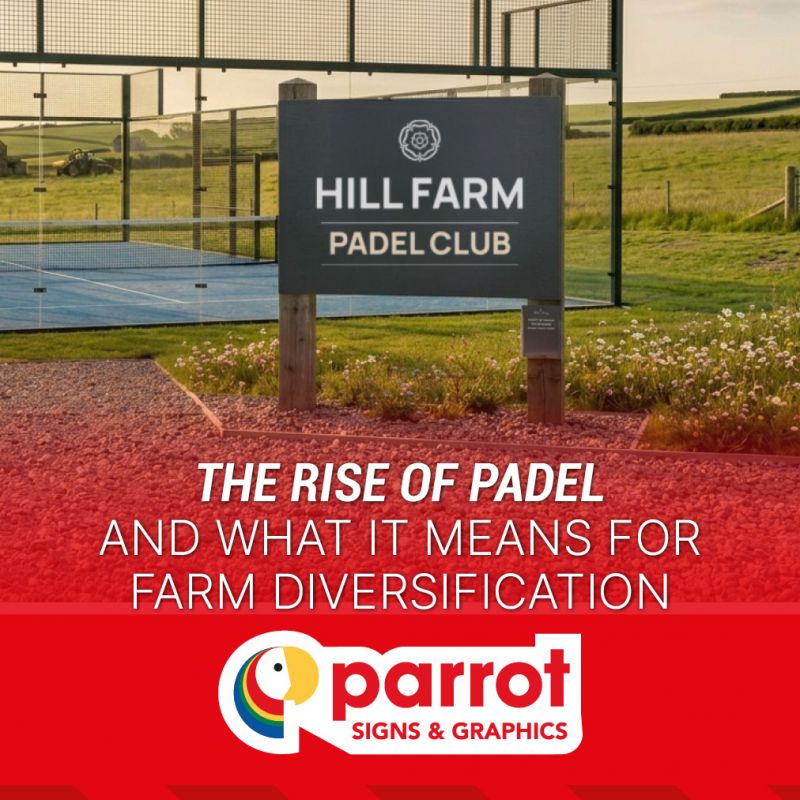
If you have driven past a building site recently and spotted a collection of glass and mesh courts taking shape, there is a good chance you have been looking at a new padel facility.
Padel has gone from a relatively niche sport to one of the UK's fastest-growing leisure activities, with new courts appearing across the country. And increasingly, those courts are finding a home in rural locations, creating an interesting new opportunity for farmers and landowners looking at diversification.
For anyone currently planning or building a padel facility, there is more to consider than the courts themselves. From parking and wayfinding to court rules, facilities and safety information, padel court signage plays an important role in creating a professional visitor experience from the moment customers arrive.
Padel is booming in the UK
Padel originated in Mexico in the late 1960s and subsequently became hugely popular in Spain and across Europe. Played on a smaller enclosed court using a combination of tennis and squash-style gameplay, it is generally played in doubles and is known for being accessible, social and relatively easy for new players to pick up.
The numbers behind its growth in Britain are striking.
The latest figures from the Lawn Tennis Association show that more than one million adults and juniors are now playing padel in Britain, with 1,825 courts across 551 venues. That's a remarkable increase from just 15,000 players in 2019
That rapid expansion means demand is not simply coming from established tennis clubs. New independent venues are being developed to cater for people who want somewhere local to play, socialise, take lessons and compete.
Why is padel becoming a farm diversification opportunity?
For farmers and landowners, diversification can provide an opportunity to make productive use of land while developing an additional source of income alongside traditional agricultural activity.
Padel is an interesting proposition because it can attract customers throughout the year rather than being dependent on a traditional agricultural season. A facility may generate income through court bookings, memberships, coaching, competitions, events and other associated activities.
There can also be opportunities to develop complementary facilities around the courts, such as cafés, changing facilities, social spaces or other leisure activities.
This is not to suggest that every piece of farmland is automatically suitable for a padel development. Planning, access, parking, local demand, utilities, noise, lighting and the character of the site all need to be considered. However, for landowners already exploring diversification, the growth of padel makes it an option worth investigating.
The trend is already being recognised within the rural property sector, with land and property specialists highlighting padel as a potential diversification opportunity for rural landowners.
Building a padel facility? Don't forget the signage
Once the courts are being installed, padel court signs may not seem like the most exciting part of the project. However, they are one of the things visitors will notice from the moment they arrive.
A new venue needs to be easy to navigate, particularly if customers are visiting for the first time. Clear signage can help visitors find their way around the site, understand the rules and locate facilities without confusion.
Typical signage requirements might include:
-
Entrance and welcome signs
-
Court identification signs
-
Court rules and etiquette signs
-
Toilet and changing facility signs
-
Reception and check-in signs
-
Accessibility signage
-
No smoking signs and other site rules
-
Café, shop or other facility signs
-
Sponsor and advertising boards
Some of these will be specific to the padel venue, while others are simply the practical signage you would expect to find around any public-facing leisure facility.
Planning the signage alongside the rest of the development can help avoid a situation where the courts are finished and operational but visitors are left wondering where to park, where to check in or where they are supposed to go.
Custom signs can make your venue stand out
There is also another reason to think about signage early: branding.
A new padel facility is a business, and its branding is an important part of how customers experience it. Rather than relying entirely on generic signs, custom padel signage can incorporate the venue's colours, logo, typography and visual identity.
A branded welcome sign can create a strong first impression. Court rules can be designed to look like part of the venue rather than an afterthought. Directional signs can follow the same visual style, creating a consistent look across the entire site.
For new facilities, this is one of the major advantages of having padel court signs made to order. Rather than choosing from a fixed selection of standard products, operators can specify what they need, how they want it to look and where it needs to be used.
Choosing the right material for your padel signs
Padel facilities present an interesting mixture of indoor and outdoor signage requirements, so the right material will depend on where each sign is going and how long it needs to last.
Options can include 3mm rigid plastic, aluminium composite such as Dibond, self-adhesive vinyl, Correx and magnetic sheet. Outdoor signs exposed to the elements may require different considerations from signs being installed inside a reception building or changing facility.
The good news is that signage does not need to be designed around a limited range of materials. A specialist sign manufacturer can help you select an appropriate option for each application.
For more information about the different materials available for safety and information signs, see our guide to choosing the right safety sign materials for your workplace.
A new opportunity for rural businesses
The rapid growth of padel is creating opportunities well beyond the sport itself. It is generating demand for new venues, coaches, equipment, hospitality and supporting services, while also giving farmers and rural landowners another potential route for diversification.
For anyone considering a padel development, the priority will naturally be getting the courts, planning and facilities right. But the smaller details matter too.
Clear wayfinding, professional padel signage and branded information signs can help turn a collection of courts into a properly finished venue, giving customers a welcoming and professional experience from the car park to the court.
With participation continuing to grow and new facilities appearing across Britain, padel looks set to become an increasingly familiar feature of the UK's rural diversification landscape.