When customers arrive at a business, their experience starts before they speak to anyone.
Finding the right entrance, knowing where to park, working out where to report and finding the right department can all shape how straightforward that first visit feels. Good signage can make these small moments much easier, particularly when someone is visiting a business for the first time.
While safety signs are an important part of signage around any business premises, they are only one part of the picture. Information and directional signs can also help customers, visitors, contractors and delivery drivers understand where they need to go and what they need to do.
For businesses that regularly welcome customers onto their premises, well-planned signage can therefore play a surprisingly important role in the overall customer experience.
The customer journey starts at the entrance
Imagine arriving somewhere you have never visited before.
You might be looking for the entrance, wondering where you can park or trying to work out whether the door in front of you is for customers, staff or deliveries.
None of these situations is particularly complicated, but uncertainty can quickly become frustrating.
Clear external signage can help answer these questions before the customer needs to ask someone.
Depending on the business, this could include:
-
Entrance signs
-
Customer parking signs
-
Visitor parking signs
-
Directions to different parts of the site
-
Customer collection signs
-
Delivery information
-
Building identification
The aim is simple: give people the information they need at the point they need it.
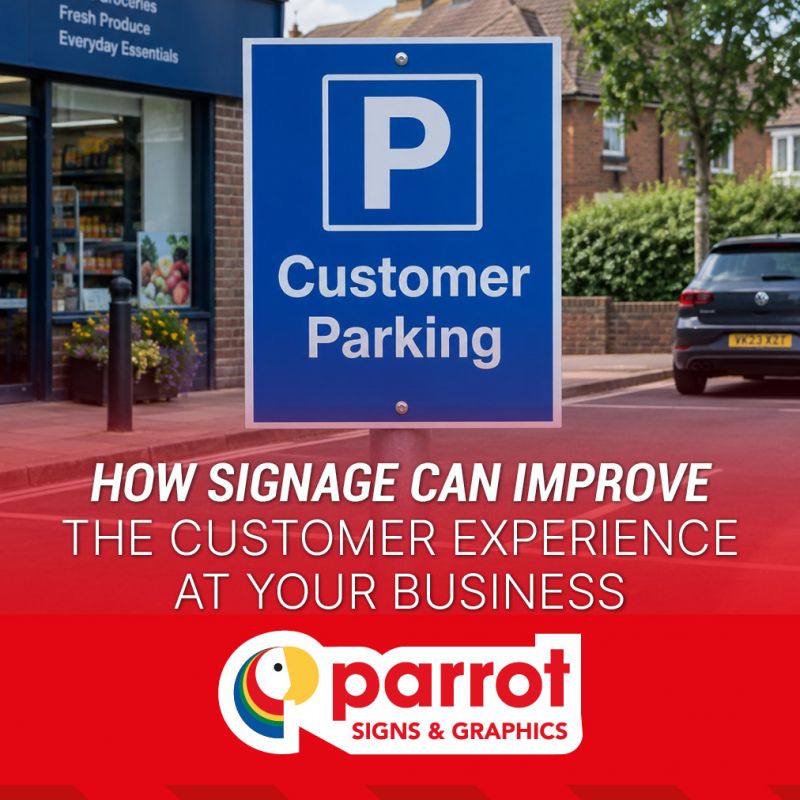
Customer parking should be easy to understand
Parking is often one of the first practical challenges a customer encounters.
A large site might have separate areas for customers, staff, visitors, deliveries and contractors. Without clear signs, people can end up driving around looking for somewhere appropriate to park or stopping in an area that is intended for another purpose.
Straightforward parking and directional signs can make the arrival process much easier.
Even on a smaller site, a clearly identified customer parking area can remove an unnecessary question from the visitor's mind.
The same applies when parking is shared with other businesses. Clear signs can help customers identify the correct entrance or premises rather than wondering whether they have arrived at the right place.
Make reception easy to find
For many businesses, reception is the natural starting point for visitors.
However, reception is not always immediately obvious, particularly in larger buildings, industrial units or premises with several entrances.
A simple Reception sign can be more useful than it sounds.
Directional signs can also help guide people from the entrance or car park towards reception. Once there, additional information can explain what visitors need to do next, such as reporting to reception or using a waiting area.
This is particularly useful for businesses that regularly receive customers who have never visited before.
Help customers find the right department
Not every customer visit ends at reception.
A customer may need to find a showroom, sales office, trade counter, collection point, customer service department or a particular member of staff.
In a larger premises, clear directional signage can prevent visitors from wandering around looking for the right destination.
For example, a business might use signs directing customers towards:
-
Sales
-
Customer Service
-
Trade Counter
-
Collections
-
Showroom
-
Accounts
-
Meeting Rooms
-
Training Facilities
-
Toilets
The terminology should reflect the way the business actually operates. This is one situation where a standard sign may not quite provide the right answer, making custom signage useful.
Clear signs can reduce interruptions for staff
Good customer signage does not just benefit visitors.
It can also save staff time.
If customers regularly ask questions such as "Where do I go?", "Where can I park?", "Where is the toilet?" or "Where do I collect my order?", employees have to stop whatever they are doing to provide directions.
One question is hardly a problem. But if the same questions are being asked repeatedly throughout the day, clear signage can remove some of those interruptions.
This is particularly valuable in busy workplaces where employees may be serving customers, handling stock, operating machinery or carrying out other tasks.
The sign effectively provides the answer before someone needs to ask.
Make collections and deliveries straightforward
For businesses that operate a collection service, the customer journey can be quite different from that of someone visiting an office.
A customer may arrive specifically to collect an order and need to know exactly where to go.
Signs such as Customer Collections, Collection Point, Goods Out or Please Report to Reception can help create a much more straightforward process.
This is also where customer signage overlaps with operational signage. The same sign may help customers, employees and drivers understand how the site works.
For businesses with busy warehouses, factories or trade counters, clear signage around goods in, goods out and collection areas can make a noticeable difference to how easily people move around the premises.
Think about customers who have never visited before
It is easy to become accustomed to your own premises.
Employees know where everything is. They know which door to use, where to park and which corridor leads to the meeting rooms. Visitors do not.
This is one of the most important things to consider when reviewing business signage. Walk around your premises as though you have never been there before.
Ask yourself:
Would I know where to go next?
If the answer is no, there may be an opportunity for a simple directional or information sign.
This does not mean covering every wall with arrows and instructions. Too many signs can create their own problems. Instead, consider the points where visitors are most likely to hesitate and provide useful information there.
Keep information clear and consistent
A business can have all the right signs and still create confusion if they do not work together.
For example, one sign might refer to a "Trade Counter", another to "Customer Service" and a third to "Sales Desk", when all three are actually directing people to the same place.
Consistency in terminology can make a signage system easier to understand.
The same principle applies to the visual appearance of signs. Using a consistent style across directional and information signage can make a premises feel more organised and considered.
This does not necessarily mean every sign needs to look identical. Different messages may need different designs. But they should feel as though they belong to the same environment.
Consider the whole customer experience
Good customer signage is about more than putting up a sign wherever there happens to be an empty wall.
Think about the complete journey.
A customer might:
Arrive → find the entrance → park → find reception → check in → locate the right department → complete their visit → find the exit
At each stage, there may be a point where clear information would make the experience easier.
This is particularly important on larger premises, where visitors may have to travel between several areas.
A business does not necessarily need a complicated signage system. It simply needs to think about the information people need and provide it at useful points along the journey.
Customer signage can reinforce your brand
Signage is also part of the physical appearance of a business.
A customer may encounter signs before they speak to anyone from the company, so the quality and presentation of those signs can contribute to their first impression.
Entrance signs, reception signs, directional information and other customer-facing signage can incorporate company branding where appropriate. Using a company logo, colours or other visual elements can help signage feel like part of the wider business environment.
This is particularly useful for businesses that have invested in creating a strong visual identity across their website, printed materials, vehicles and premises.
Don't forget the less obvious information
Customer signage does not have to be limited to destinations.
Sometimes visitors need practical information about how a facility works.
This could include signs explaining:
-
Where to wait
-
Where to collect an order
-
Where to return equipment
-
Where customers should report
-
Where toilets are located
-
Which areas are for staff only
-
Where customers should leave completed paperwork
-
Where to find a particular service
These signs can be particularly useful where customers interact with a business without needing an employee to guide them through every stage.
Custom signs can solve specific problems
Every business is different, which means there will always be situations where an off-the-shelf sign does not quite say what is needed.
A company might use an unusual name for a department, have a specific collection process or need to combine a direction with additional information.
Custom signage provides a way to create signs around the actual requirements of the business. This could be as simple as changing the wording on an existing design or creating a completely bespoke sign with specific wording, branding, sizing or other requirements.
For businesses with unusual layouts or customer journeys, this flexibility can be particularly useful.
What makes customer signage effective?
The best customer signage is not necessarily the largest or most noticeable.
It is signage that provides useful information clearly, at the point where people need it.
When reviewing your own premises, consider:
-
Is the message clear?
-
Can customers read it easily?
-
Is it positioned where they are likely to look?
-
Does it use terminology customers will understand?
-
Does it direct people towards the right destination?
-
Does it fit with other signs around the premises?
-
Is the information still accurate?
-
Does the sign look appropriate for the environment?
Small improvements can sometimes make a surprisingly large difference.
Good signage helps customers feel more confident
Customers do not usually visit a business specifically to admire its signs.
That is actually a good thing.
The most effective signage often works quietly in the background, helping people find their way without requiring assistance.
A visitor who can park easily, find reception, locate the right department and understand what to do next is likely to have a more straightforward experience than someone who has to search for information at every stage.
For businesses, that can mean fewer interruptions for staff, less confusion and a more organised customer journey.
Signage is only one part of the customer experience, of course. But when it is clear, consistent and designed around the people using the premises, it can make the physical experience of visiting a business considerably easier.
At Parrot Signs & Graphics, we manufacture a wide range of safety, information, directional and custom signs for businesses across the UK. From simple reception and parking signs to bespoke customer information and directional signage, the right signs can help make your premises easier to navigate and more welcoming for the people who use them.