
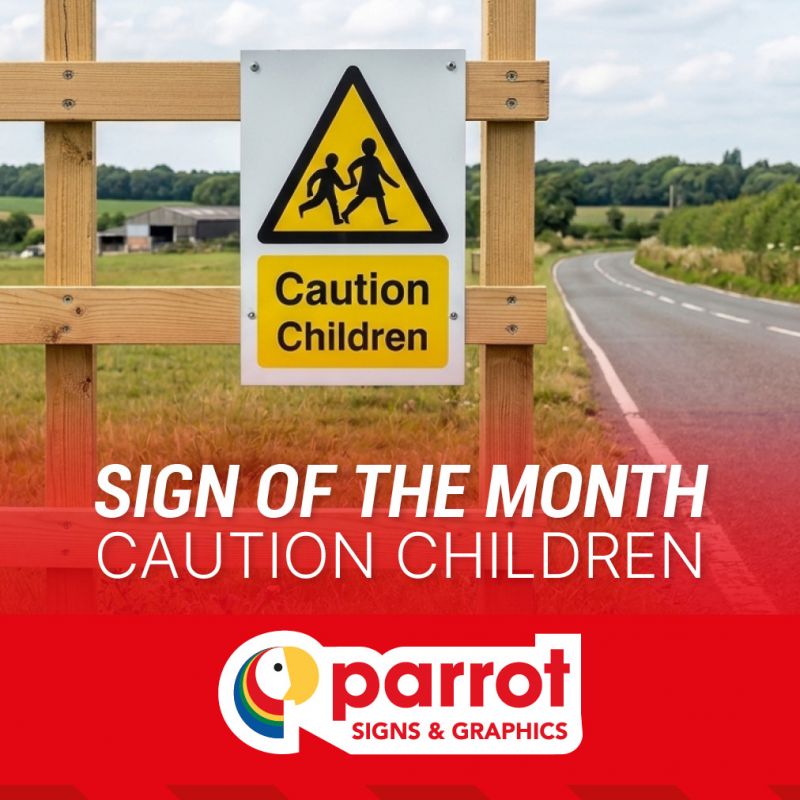
As the days get shorter and the evenings draw in, drivers need to be particularly aware of pedestrians who may be harder to see. Children walking home from school, playing near their homes or moving between properties can be difficult to spot, especially in poor weather or fading light.
For owners and managers of private roads, lanes and shared accessways, a Caution Children safety sign can help alert drivers to the potential presence of young pedestrians and encourage them to take extra care.
Our Sign of the Month is the Caution Children Sign, designed to warn drivers and passers-by that children may be in the area. But can you put up this type of safety sign on a private road, and what should you consider before installing one?
Why Use a Caution Children Safety Sign?
Children do not always behave like predictable adult pedestrians. They may run out unexpectedly, become distracted or be less aware of approaching vehicles. Even where children understand basic road safety, drivers still need to anticipate the possibility of someone entering the road.
Reduced daylight adds another challenge. During autumn and winter, children may be walking home from school in the dusk or dark, when visibility can be affected by poor weather, shadows and inadequate street lighting.
The risk to children travelling on foot is reflected in official road safety statistics. According to the Department for Transport, 46% of child casualties killed or seriously injured on roads in Great Britain during weekdays between 2021 and 2025 occurred between 3pm and 5.59pm. This overlaps with the period when many children are making their way home from school, often during the fading daylight of autumn and winter. While these figures cover roads across Great Britain rather than private roads specifically, they underline the importance of drivers remaining alert to young pedestrians.
The Royal Society for the Prevention of Accidents (RoSPA) advises teaching children to stop, look, listen and think before crossing a road. It also highlights the importance of being visible to motorists, particularly during darker mornings and evenings. You can read more in RoSPA's child pedestrian safety guidance.
A warning sign cannot eliminate these risks, but it can provide a useful reminder to drivers that children may be present. This can be particularly relevant on private roads serving residential properties, private estates, shared driveways and lanes used by pedestrians as well as vehicles.
Can You Put Up Safety Signs on a Private Road?
In general, landowners can display appropriate notices on their property, but the rules around signs intended to warn or direct road users depend on the circumstances. Private ownership does not automatically mean that a road is outside the scope of traffic sign regulations.
Some privately owned roads are accessible to the public or subject to public rights of way, while others are restricted to residents, visitors or authorised users. The distinction matters because the legal requirements can depend on the road's status, the type of sign and the message it conveys.
Section 64 of the Road Traffic Regulation Act 1984 sets out the legal framework for traffic signs, including signs prescribed by regulations or authorised by the relevant authority. Not every warning notice sold commercially is necessarily an official traffic sign, so it is important to distinguish between a general warning displayed on private property and a sign intended to regulate traffic.
The Health and Safety Executive (HSE) provides further guidance in its resource on signs, signals and road markings in workplaces. It explains that traffic signs used to warn or inform drivers and pedestrians in private workplaces must match those used on public roads wherever a suitable sign exists. This helps ensure that road users can recognise signs and understand their meaning.
However, this guidance specifically concerns workplace traffic routes. It should not be taken as a definitive statement about the rules for every private residential road or lane.
If you are considering installing a Caution Children safety sign, establish who owns and manages the road and check whether any permissions or restrictions apply. Where the road connects to a public highway, or the proposed sign could affect traffic using a public road, contact the relevant local highway authority for advice. If the road is managed by a residents' association or property management company, check whether approval is required.
Taking these steps can help you choose an appropriate sign and avoid making assumptions about what is permitted.
Choosing the Right Safety Sign for Your Private Road
The most suitable safety sign will depend on the location, the type of traffic using the road and the message you want to communicate.
The Caution Children Sign from Parrot Signs & Graphics is a straightforward option for alerting motorists to the possible presence of children without specifying a particular speed limit or crossing point. It may be suitable for a residential lane or shared accessway where children could be walking nearby.
Other signs may be worth considering, depending on the circumstances:
-
5 MPH Beware Children Sign: combines a warning about children with a numerical speed message. Before displaying a specific speed limit, check whether it is appropriate and legally enforceable in that location.
-
Please Drive Slowly Sign: offers a general reminder for drivers to take care when using private roads, driveways and access lanes.
-
Slow Children Crossing Sign: alerts drivers to the potential presence of children crossing the road.
Consider the sign's size, position and visibility before installation. Drivers need enough time to notice and read a warning before reaching the area where children may be present. Avoid placing signs where parked vehicles, vegetation or other obstacles could obscure them.
The HSE also recommends keeping signs clear, visible and well maintained. Where signs need to be seen in darkness, reflective materials and suitable lighting may be important considerations.
What Else Can Help Keep Children Safe Near Private Roads?
Safety signs are most useful when they form part of a wider approach to reducing risk. They can alert drivers to a potential hazard, but they cannot guarantee that motorists will slow down or that children will remain safe.
Depending on the location, practical measures may include:
-
Keeping sightlines clear around entrances, bends and junctions.
-
Ensuring that lighting is adequate where children and vehicles share the same space.
-
Encouraging residents and visitors to drive at an appropriate speed and remain alert.
-
Checking that vehicles can enter and leave driveways without creating unnecessary risks for pedestrians.
-
Reviewing the position and condition of existing signs regularly.
Parents and carers can also help by teaching children to use safe crossing practices and encouraging them to wear reflective items when walking in poor light. Drivers, meanwhile, should remain alert to pedestrians and take particular care when visibility is reduced.
Order a Caution Children Safety Sign from Parrot Signs & Graphics
A Caution Children safety sign can be a useful way to remind drivers that young pedestrians may be nearby, particularly on residential lanes and private access roads.
The Caution Children Sign from Parrot Signs & Graphics is available in a choice of materials, including 3mm rigid plastic, aluminium composite and self-adhesive vinyl. The most appropriate option will depend on where and how the sign will be installed.
Before putting up a sign, check the status of the road, any applicable permissions and the suitability of the proposed location. A well-positioned warning can help raise awareness, but it should complement other sensible measures to protect pedestrians.
Explore the range of safety signs from Parrot Signs & Graphics to find a suitable option for your premises.