Construction sites are busy environments where people, vehicles, plant, materials and deliveries can all be moving around at the same time. With so much happening, clear signage has an important role to play in communicating information quickly and helping people understand how different areas of a site are organised.
From familiar PPE signs at the entrance to pedestrian routes, warning signs and site information boards, construction sites feature a wide variety of signage. Some signs are permanent, while others may be changed as the project develops. Some provide straightforward instructions, while others simply help people find their way around.
Here are 10 common signs and signage features you are likely to see on a construction site.
1. Construction Site Safety Boards
One of the most recognisable features at the entrance to a construction site is a site safety board. Unlike an individual safety sign, a site board can bring together a range of important information in one prominent location.
A site safety board can include general site information, safety notices, emergency information, company details and other project-specific content. It can also provide space for documents and information that need to be updated throughout the life of a project.
At Parrot Signs & Graphics, we have developed a folding construction site safety board that can be customised around the needs of an individual site. The lightweight Correx design folds for easier transportation between projects, while custom pockets can be incorporated for items such as RAMS, permits and inspection sheets.
The boards can also include QR code areas, company branding and bespoke layouts, making them a practical option for construction companies managing different sites and projects.
- For more information, see our article about our practical folding construction site safety board.
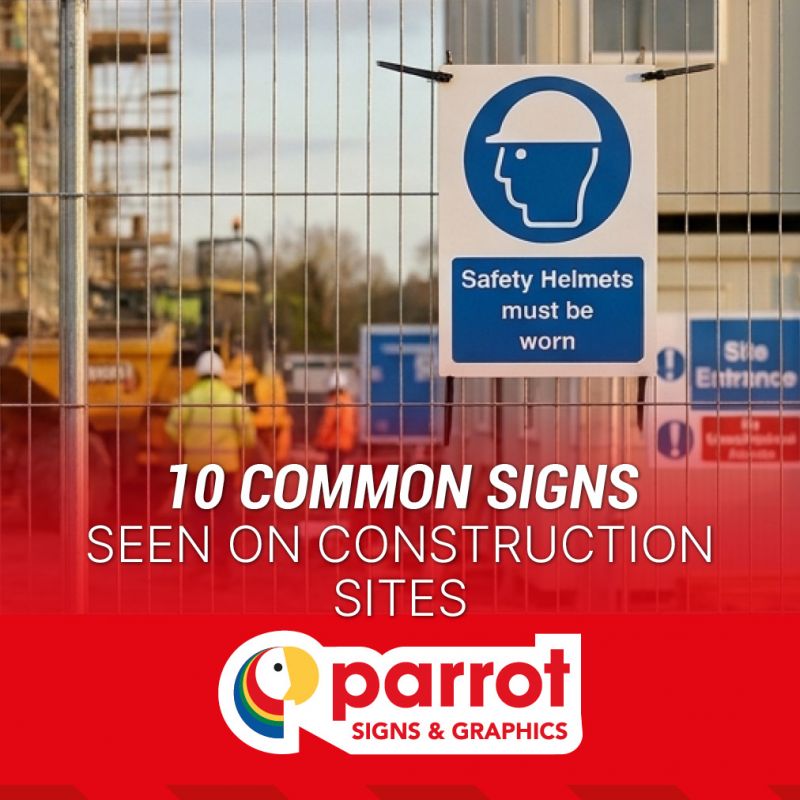
2. Safety Helmets Must Be Worn Signs
The familiar hard hat symbol is one of the most recognisable images associated with construction.
Safety helmets must be worn signs are commonly positioned at site entrances and around areas where head protection is expected. They are usually presented using the familiar blue mandatory sign format, making them easy to identify at a glance.
For visitors arriving at a construction site, these signs can be particularly useful because they provide a clear visual reminder of the type of personal protective equipment associated with the site.
The symbol itself can often communicate the message before someone has even read the accompanying words, which is one of the reasons standardised safety symbols are so widely used.
3. Foot Protection Must Be Worn Signs
Safety boots are another familiar part of a construction site.
Foot protection must be worn signs use the recognisable mandatory action format to indicate that appropriate footwear is expected within the designated area. They can commonly be found alongside other PPE signs at entrances, welfare areas or access points.
Construction sites can vary considerably in their layout and activities, so PPE signage may appear in different locations depending on how a particular site operates.
Grouping several PPE signs together can also create a clear and consistent visual message. Rather than relying on a large amount of written information, familiar symbols allow people to identify the required equipment quickly.
4. High Visibility Clothing Must Be Worn Signs
High visibility clothing is another familiar sight on construction sites, particularly where people are working around moving vehicles and plant.
Signs featuring the high visibility clothing symbol are commonly displayed at site entrances or around areas where visibility is particularly important.
Like other PPE signs, these are designed to communicate a simple message without requiring a lengthy explanation. The familiar blue mandatory format and recognisable symbol make the sign easy to identify as people move around the site.
For construction companies operating several projects, consistent signage can also help create a familiar visual identity across different sites.
5. Pedestrian Route Signs
Construction sites are rarely static. As work progresses, access routes can change, equipment can be moved and areas can be closed or opened.
Pedestrian route signs help direct people around the site and can be particularly useful where there is a distinction between pedestrian areas and routes used by vehicles or plant.
Directional signs can include arrows, words, symbols or a combination of these, depending on the information being communicated.
Good wayfinding signs do not necessarily need to be complicated. A clearly positioned sign showing the direction to follow can be much easier to understand than relying on someone to work out where they should go.
For construction sites with changing layouts, the ability to replace or reposition signs can also be useful.
6. Danger Fork Lift Trucks Signs
Construction sites can involve a wide range of vehicles and mobile plant, from delivery vehicles and telehandlers to forklifts and other equipment.
Fork lift trucks operating signs are commonly seen around areas where these vehicles are in use or where people may need to be aware of their presence.
These signs use a familiar warning symbol to communicate the potential presence of moving vehicles. They may be particularly useful around storage areas, loading zones, materials handling areas and access routes.
Construction sites can be visually busy, so a clearly positioned sign can provide another useful indication of what people can expect when entering a particular area.
7. Danger Deep Excavation Signs
Deep excavations are a particularly recognisable feature of some construction projects, whether work involves foundations, drainage, utilities or other below-ground activities.
Danger deep excavation signs provide a straightforward visual warning around areas where excavation work is taking place.
Unlike more general workplace signs, this is an example of signage that can be highly specific to the work being carried out on a particular site.
The need for particular warning signs can therefore change as a construction project progresses. A sign that is relevant during groundwork may no longer be required once that phase of the project has been completed, while new signage may become relevant as work moves on to another stage.
This is one reason why construction signage often needs to be flexible and adaptable.
8. Overhead Cables Signs
Overhead cables can present another site-specific consideration, particularly where construction equipment, vehicles or other tall objects are operating nearby.
Overhead cables signs provide a clear visual warning to people approaching or working in the relevant area.
As with excavation signs, these are a good example of how construction signage can reflect the particular characteristics of an individual project. Not every site will have the same hazards, access arrangements or working conditions.
This is also where custom signage can be useful. Construction companies may need signs that communicate information specific to their site rather than relying entirely on a standard collection of generic signs.
9. First Aid Signs
Not every sign on a construction site is a warning or instruction.
Green first aid signs are a familiar feature of many workplaces, including construction sites. They help people identify where first aid facilities or equipment can be found, making them an important part of site wayfinding.
Because the first aid symbol is widely recognised, the sign can communicate useful information even when someone is unfamiliar with the site.
Other safe condition signs may also be found around construction sites, including emergency exit, emergency shower or eyewash signs where appropriate facilities are available.
These green signs provide a useful reminder that construction signage is not simply about identifying hazards. It also helps people find important facilities and navigate the site.
10. Site Office and Directional Signs
Construction sites can become surprisingly complex, particularly on larger developments.
Site offices, welfare facilities, meeting areas, delivery points, entrances and other locations may all need to be identified. Directional signage helps people find their way without having to rely on someone being available to provide directions.
Site office signs are a simple example, but directional signage can also be used to identify reception areas, pedestrian entrances, delivery routes and other parts of a project.
This type of signage can be particularly useful for visitors, contractors and delivery drivers who may not be familiar with the site.
Clear directional signs can also help separate different types of traffic and make the overall site easier to navigate.
Construction Site Signage Needs to Change as Projects Develop
One of the interesting things about construction signage is that a site is rarely the same from one month to the next.
Groundworks, structural work, internal fit-out and finishing stages can all create different requirements for information and wayfinding. Temporary access routes may change, new areas may open and hazards associated with earlier stages of the project may disappear.
This means construction companies often need a combination of standard signs, temporary signage, directional signs, custom signs and larger information boards.
It is also one reason why portable signage can be useful. A sign or board that can be transported between projects can provide a practical alternative to producing a completely new solution for every location.
Custom Construction Signage for Individual Projects
While many construction signs use familiar symbols and standard messages, there is also a place for bespoke signage.
Every construction project is different. A particular site may have its own branding, terminology, access arrangements, visitor instructions or information that needs to be communicated clearly.
At Parrot Signs & Graphics, we produce a wide range of construction signage, from individual safety and warning signs to branded signs, perimeter signs for HERAS fencing, vehicle and plant signs and custom site safety boards.
Signs can be produced in a range of materials depending on where and how they will be used. Options include lightweight fluted Correx, rigid Foamex, self-adhesive vinyl, magnetic sheet and aluminium composite.
For construction companies working across multiple projects, this flexibility can be particularly useful. Some signs may need to be lightweight and easy to move, while others may need to withstand longer-term outdoor use.
Frequently Asked Questions
What types of signs are commonly found on construction sites?
Construction sites can feature a wide variety of signage, including PPE signs, hazard warnings, directional signs, pedestrian route signs, vehicle and plant signs, first aid signs, site information boards and bespoke project-specific signage.
Are construction site signs always permanent?
No. Some construction signage is designed for longer-term use, while other signs may be temporary or moved as the project develops. The appropriate solution depends on the site, the information being communicated and how long the sign is expected to be used.
Can construction site safety boards be customised?
Yes. A construction site safety board can be designed around the information and features required for a particular project. At Parrot Signs & Graphics, our folding site safety boards can include custom pockets, QR code areas, company branding and bespoke layouts.
What materials can construction site signs be made from?
Construction signs can be produced in a variety of materials, including Correx, Foamex, self-adhesive vinyl, magnetic sheet and coated aluminium. The best option depends on factors such as whether the sign is being used indoors or outdoors, whether it needs to be portable and how long it is expected to remain in place.
Can construction signs be branded?
Yes. Construction signage does not have to be purely functional. Company branding, project information and bespoke graphics can be incorporated into many types of construction signage, helping create a consistent appearance across a project.
Construction Signs for Busy Working Environments
Construction sites rely on clear communication, and signage is one of the most visible ways of providing it. From familiar PPE symbols and hazard warnings to pedestrian routes, directional signs and larger site safety boards, different types of signage can serve very different purposes.
The requirements of a construction project can also change as work progresses, which is why flexibility can be just as important as durability.
At Parrot Signs & Graphics, we produce safety, information, directional and custom signs for construction sites across the UK. Whether you need individual signs, branded site signage or a bespoke folding construction site safety board designed around your project, we can help create a solution to suit your requirements.